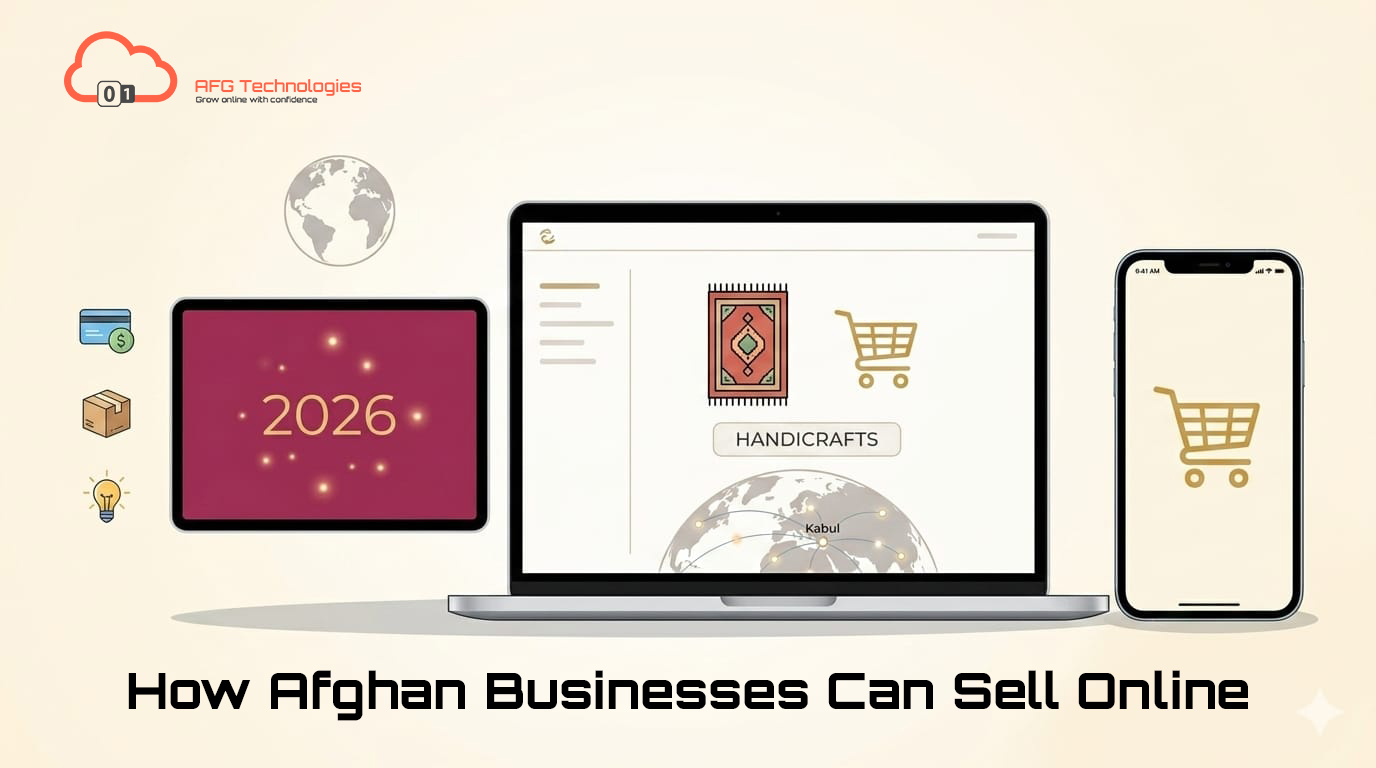
Afghanistan has over 9 million internet users, a diaspora of 5 - 6 million people spread across Europe, North America, and the Gulf, and a growing number of consumers comfortable buying things online. If you run a business in Afghanistan and you're not selling online yet, you're missing customers every single day.
This guide covers everything you need to start selling online as an Afghan business in 2026: the platforms, the payment options, the real challenges, and the exact steps to take.
Table of Contents
1. Can Afghan Businesses Really Sell Online? {#can-they}
Yes - with some honest caveats.
Selling online from Afghanistan comes with real challenges: limited payment infrastructure, inconsistent logistics in some areas, and a customer base still building trust in online transactions. But thousands of Afghan businesses are already doing it successfully.
The key is understanding what to sell, where to sell it, and how to handle payment and delivery within Afghanistan's specific context.
Afghan businesses already selling online successfully:
Saffron exporters selling to Europe, the USA, and Gulf countries
Carpet and kilim sellers reaching international buyers
Dried fruit and nut producers supplying diaspora communities
Clothing and traditional dress businesses
IT services and freelancers working with international clients
Handicraft and jewelry makers
Local food delivery services in Kabul and Herat
Software companies building products for global markets
If other Afghan businesses are doing it, yours can too.
2. What Sells Well Online from Afghanistan {#what-sells}
Not every product is equally suited for online selling. Here's a realistic breakdown.
Products That Work Really Well Online
Afghan saffron. Afghanistan produces some of the world's finest saffron. International buyers pay $10 - $20 per gram. A small producer can earn serious income selling directly to consumers in Europe or North America. Low weight, high value - it's ideal for shipping internationally.
Carpets and kilims. Afghan carpets are recognized worldwide. High value, unique, and appreciated by international buyers. Shipping is expensive due to weight and size, but the margins justify it.
Dried fruits and nuts. Afghan raisins, pistachios, almonds, apricots, and pomegranate products have strong demand in diaspora communities and among health-conscious consumers internationally.
Handmade jewelry and accessories. Low weight, unique, artisan-made. Appeals strongly to ethical and fair-trade consumers internationally.
Traditional clothing and textiles. Chapan, kuchi jewelry, embroidered fabric. A niche market but one with loyal international customers.
IT services and freelancing. Web development, graphic design, translation, data entry. No shipping required. Afghan professionals can earn international rates working remotely.
Digital products. Online courses in Dari/Pashto, e-books, templates. Zero shipping cost and high margins.
Products That Sell Well Domestically Online
Food delivery. Kabul, Herat, and Mazar-i-Sharif have growing food delivery markets.
Electronics and gadgets. High demand, but competition is fierce.
Clothing and fashion. The domestic online market for clothing is growing, especially among urban consumers.
Education and tutoring. Online tutoring in English, math, and professional skills has real demand.
3. The 4 Ways to Sell Online in Afghanistan {#4-ways}
Option 1 - Social Commerce (Facebook, Instagram, WhatsApp)
The most common starting point for Afghan businesses. You showcase products on Facebook or Instagram, customers message you on WhatsApp, and you arrange payment and delivery.
Pros: Free to start, large Afghan audience already there, no technical setup needed Cons: Your business doesn't appear in Google search, the platform can shut down your page, no professional appearance, hard to scale
Best for: Complete beginners, local product businesses, testing whether your product actually sells
Option 2 - Your Own E-commerce Website
A dedicated online store at your own domain, powered by WooCommerce (WordPress), Shopify, or a custom-built solution.
Pros: Professional, shows up in Google search, you own it, builds long-term brand equity, scales well Cons: Requires upfront investment ($800 - $3,000+), payment gateway challenges in Afghanistan
Best for: Serious businesses planning for long-term growth, export-focused businesses
Option 3 - International Marketplaces
Listing products on platforms like Etsy (handmade and artisan goods), Amazon Handmade, or eBay.
Pros: Instant access to millions of international buyers, built-in payments, established trust Cons: Requires a foreign bank account or payment service, high competition, marketplace fees of 10 - 20%, limited brand-building
Best for: Artisan product sellers and saffron exporters wanting to reach international markets quickly
Option 4 - B2B Online Sales
Selling to other businesses rather than consumers, using Alibaba, TradeIndia, or direct outreach via LinkedIn and email.
Pros: Larger order sizes, longer relationships, less price pressure Cons: Longer sales cycles, requires professional documentation and export capability
Best for: Saffron producers, dried fruit exporters, textile manufacturers
4. Payment Methods for Afghan Online Businesses {#payments}
Payment is the most commonly cited challenge for Afghan e-commerce. Here's the full picture.
For Domestic Sales (Within Afghanistan)
Cash on delivery (COD) is the dominant method, accounting for an estimated 70 - 80% of all domestic online orders. The customer pays the delivery person in cash when the package arrives. This eliminates payment risk for customers but adds logistics complexity for you.
M-Paisa. Afghanistan's mobile money system operated by Roshan. Available to millions of Afghans and increasingly used for online purchases. Works via mobile without requiring a bank account.
Bank transfer. Used for larger orders. Requires both parties to have bank accounts. Afghan Telecom Bank, Azizi Bank, and Bank-e-Millie Afghan are common options.
In-person payment. For local businesses, many customers still prefer to visit and pay in person, even after finding you online.
For International Sales (Diaspora and Export)
PayPal. Technically available but restricted in Afghanistan. Most Afghan exporters use a foreign-registered PayPal account through a family member abroad or an intermediary.
Stripe. Not directly available in Afghanistan. Requires a foreign bank account. Afghan businesses registered in the UK, USA, or UAE can use Stripe.
Wise (formerly TransferWise). Popular for receiving international payments. Lower fees than traditional bank transfers.
Bank wire transfer (SWIFT). Standard for larger export transactions. Requires a verified Afghan bank account and export documentation.
Hawala. Afghanistan's traditional informal money transfer system. Still widely used for cross-border transactions. Can't be integrated directly into a website, but used for settlement between buyer and seller.
USDT (Tether). Growing among tech-savvy Afghan entrepreneurs for cross-border transactions due to USD stability.
Practical Recommendation
For most Afghan businesses just starting out:
Start with WhatsApp orders and cash on delivery or M-Paisa
Add M-Paisa as a payment option when you build your website
If you're exporting, open a bank account in the UAE or UK and use Wise or Stripe from there
5. Shipping and Delivery in Afghanistan {#shipping}
Domestic Shipping
Several courier services operate within Afghanistan.
Service | Coverage | Approximate Cost |
|---|---|---|
Afghanistan Post | Nationwide | Low cost, slow |
Salaam Delivery | Kabul + major cities | 80 - 200 AFN ($1 - $2.60) |
TCS Afghanistan | Kabul + major cities | 150 - 300 AFN |
DHL Afghanistan | Kabul (international) | $30 - $80+ |
Local motorcycle couriers | City-level delivery | 50 - 150 AFN |
For Kabul-based businesses, same-day or next-day delivery is achievable in most districts. Inter-provincial delivery is slower and less reliable.
International Shipping for Exports
Air freight is the most practical option for small, high-value shipments like saffron or jewelry. Kabul International Airport handles cargo. DHL, FedEx, and Aramex all operate in Kabul.
Sea freight works for larger shipments like carpets or bulk dried fruit, routed via Karachi port in Pakistan or Bandar Abbas port in Iran.
Cost estimates for small export packages under 5kg:
Kabul to Dubai: $25 - $60
Kabul to Germany: $50 - $120
Kabul to USA: $60 - $150
Costs fluctuate and vary by carrier.
6. How to Build Your Afghan Online Store Step by Step {#steps}
Step 1 - Define What You're Selling and to Whom
Before building anything, get clear on:
What exactly are you selling?
Who is your customer - local Afghans, diaspora, international buyers?
What's your price point?
How will you handle delivery?
The answers determine which approach makes sense.
Step 2 - Register Your Domain Name
Buy a .com domain for your business. For example, afghansaffron.com or kabulcarpets.com. A domain costs $12 - $18/year. This is your permanent online address. Own it even before you build your website.
Step 3 - Get Web Hosting
Choose a reliable hosting provider that offers fast servers, a free SSL certificate, one-click WordPress installation, and 24/7 support. Shared hosting from AfgTechnologies starts at $59.99/year and includes everything you need to start.
Step 4 - Build Your Online Store
For most Afghan small businesses, WordPress plus WooCommerce is the right choice.
Install WordPress (one click from your hosting control panel)
Install WooCommerce (free plugin that turns WordPress into an online store)
Choose a mobile-responsive theme (Astra or Storefront are free and fast)
Add your products with clear photos, descriptions in Dari/Pashto/English, and prices
Configure your payment options (COD, M-Paisa, bank transfer)
Set up your shipping zones and rates
Total cost: ~$100 - $300 if you do it yourself, or $500 - $1,500 if you hire an Afghan developer.
Step 5 - Add the Essential Pages
Every Afghan online store needs:
Home page - clear value proposition and featured products
Product pages - high-quality photos, clear descriptions, pricing in both USD and AFN
About page - who you are, where you're located, your story
Contact page - WhatsApp button, phone, email, physical address (builds trust)
Shipping info - how long delivery takes, how much it costs
Returns policy - even a simple one builds customer confidence
Step 6 - Set Up WhatsApp Business
Install WhatsApp Business (free) on your phone and:
Set your business name, description, and address
Create a product catalog
Set up automated greeting and away messages
Add your WhatsApp link to every page of your website
This one step typically doubles the number of inquiries a website generates in the Afghan market.
Step 7 - Get Found on Google
Once your store is live:
Submit your website to Google Search Console (free)
Create a Google Business Profile (free) - critical for local search
Write 2 - 3 blog posts targeting keywords your customers actually search for
Get listed on directories like Clutch or local Afghan business directories
Step 8 - Promote Your Store
Share on your personal and business Facebook page
Post product photos on Instagram with relevant hashtags
Join Afghan Facebook business groups and share your store
Ask satisfied customers to recommend you
Consider a small Facebook ads budget of $5 - $20/day targeting Afghans in your province or diaspora communities abroad
7. Selling to the Afghan Diaspora {#diaspora}
The Afghan diaspora is one of the best opportunities for Afghan online businesses, and most businesses aren't targeting them properly yet.
Who they are: An estimated 5 - 6 million Afghans live outside Afghanistan, with large communities in:
Pakistan (~3 million)
Iran (~2 million)
Germany (~250,000)
USA (~150,000)
UK (~100,000)
Australia, Canada, Netherlands, Sweden, UAE (significant communities in each)
What diaspora Afghans want to buy:
Afghan food products - saffron, dried fruits, nuts, spices
Traditional clothing for weddings and Eid
Handmade goods - carpets, kilims, jewelry, pottery
Books and educational materials in Dari/Pashto
Anything authentically Afghan that reminds them of home
How to reach them:
Facebook groups for Afghan diaspora communities in specific countries
Instagram with both English and Dari/Pashto captions
SEO for terms like "buy Afghan saffron online" or "Afghan carpet shop"
Partnering with Afghan diaspora YouTubers and influencers
Payment from diaspora customers is much easier. They have PayPal, credit cards, and international banking. This removes the biggest obstacle Afghan domestic e-commerce faces.
8. Common Mistakes Afghan Businesses Make Online {#mistakes}
Using only a Facebook page as your website. Facebook pages don't appear in Google product searches. A website does.
No mobile optimization. Over 87% of Afghan internet users are on mobile. If your website isn't mobile-friendly, you're losing 87% of potential customers before they even see your products.
No WhatsApp button. Afghan customers want to ask questions before buying. If they can't reach you on WhatsApp instantly, they leave.
Bad product photos. Phone photos taken in poor lighting don't convert. A white background and good natural light makes a significant difference. It doesn't require expensive equipment.
Prices only in USD. Domestic Afghan customers think in AFN. Show both currencies. International customers need USD. Show both.
No trust signals. Afghan online buyers are cautious. Your website needs a physical address, phone number, customer reviews, and a clear return policy.
Giving up too soon. Online selling takes time. Most Afghan e-commerce stores take 3 - 6 months to get their first regular customers. The businesses that stick with it are the ones that succeed.
9. Real Costs of Selling Online in Afghanistan {#costs}
Item | Cost |
|---|---|
Domain name | $12 - $18/year |
Web hosting (shared) | $60 - $120/year |
WooCommerce (e-commerce plugin) | Free |
WordPress theme | $0 - $80 one-time |
Website setup (if hiring a developer) | $500 - $1,500 one-time |
Product photography | $100 - $300 |
WhatsApp Business | Free |
Google Business Profile | Free |
Facebook/Instagram ads | $20 - $200/month (optional) |
Payment gateway fees (if international) | 2.5 - 5% per transaction |
Minimum to start (doing it yourself): ~$80 - $100/year Recommended starting budget: ~$700 - $1,500 total for year one
10. Frequently Asked Questions {#faqs}
Is it safe to sell online in Afghanistan?
For domestic sales, the main risk is COD orders where the customer refuses delivery. You can manage this by taking a deposit upfront for larger orders. For international sales, using Wise or bank transfer gives you solid protection.
Do I need a trade license to sell online in Afghanistan?
For small informal sales through social media, trade licenses aren't typically enforced. For a registered business with a website operating at any real scale, registering with the Afghanistan Central Business Registry (ACBR) provides legal protection and is the right thing to do.
Can I sell on Amazon from Afghanistan?
Directly creating an Amazon seller account from Afghanistan is restricted. However, many Afghan businesses sell on Amazon through a company registered in the UAE, UK, or USA, often through a family member or business partner abroad.
How do I handle returns for online orders?
For domestic sales, "exchange within 7 days if the product is damaged or significantly different from the description" is a reasonable standard policy. For international sales, consider "no returns but replacement for damaged goods" given the high shipping costs involved.
What's the best platform to sell Afghan carpets online?
Etsy is the most popular platform for selling Afghan carpets internationally. eBay is also used. For higher-end carpets, having your own website with good Google visibility often yields better margins than paying 10 - 20% marketplace fees.
How long until I start making sales online?
Most Afghan businesses with a proper website and active social media see their first online sales within 1 - 3 months. Consistent regular sales typically take 3 - 6 months of sustained effort.
The Afghan digital economy is at an inflection point. The businesses building their online presence now will capture the growing market of Afghan internet users, both domestically and in the diaspora.
You don't need a big budget to start. A domain, good hosting, WordPress, and WhatsApp Business is enough to launch a professional online store for under $200 in the first year.
AfgTechnologies offers web hosting from $59.99/year, free website migration, and 24/7 support in Dari, Pashto, and English. Get started today or contact us on WhatsApp.
AfgTechnologies - Afghanistan's trusted web hosting and digital services provider. Serving businesses across all 34 provinces.